Wireless Driveway Alarm and Beam-Break Monitoring for Remote Sites
Create an early warning at the edge of a property by detecting vehicles, people, livestock and equipment as they cross a driveway, gate or access track. Telemetry2U combines a long-range low-power infrared sensor, passive reflector, solar telemetry node and cloud alerts in a practical plug-and-play system.
Early Warning. Solar Power. Simple Installation.
Place the beam across a driveway, gate or access track to detect activity before it reaches buildings, equipment or people. The sensor and node install at one end, while the passive reflector requires no mains power or cabling.
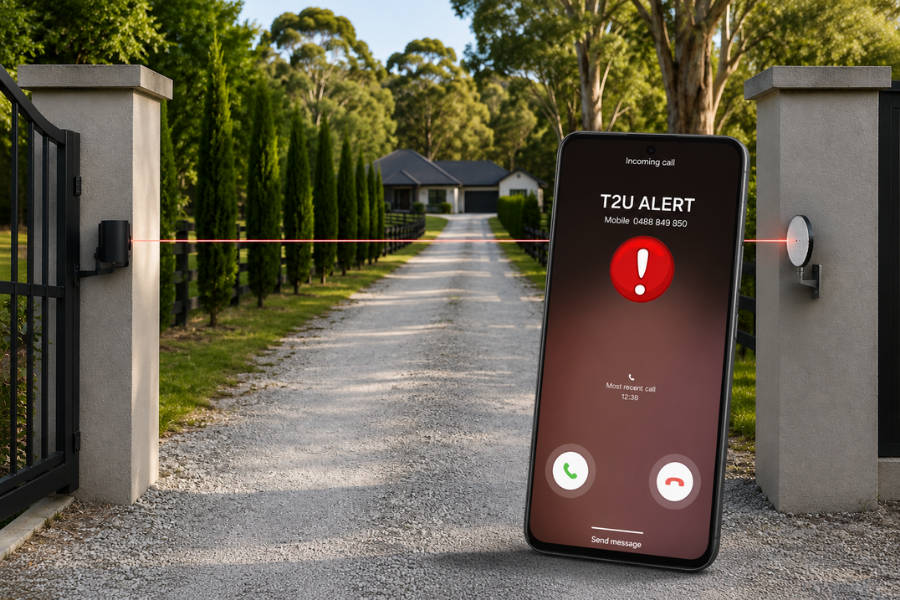
Install Long-Range Detection Without Wiring Both Sides
Conventional beam systems can require powered equipment at both ends of the monitored path. The Telemetry2U design keeps the electronics, power and communications together at the sensor end and uses a passive reflector opposite.
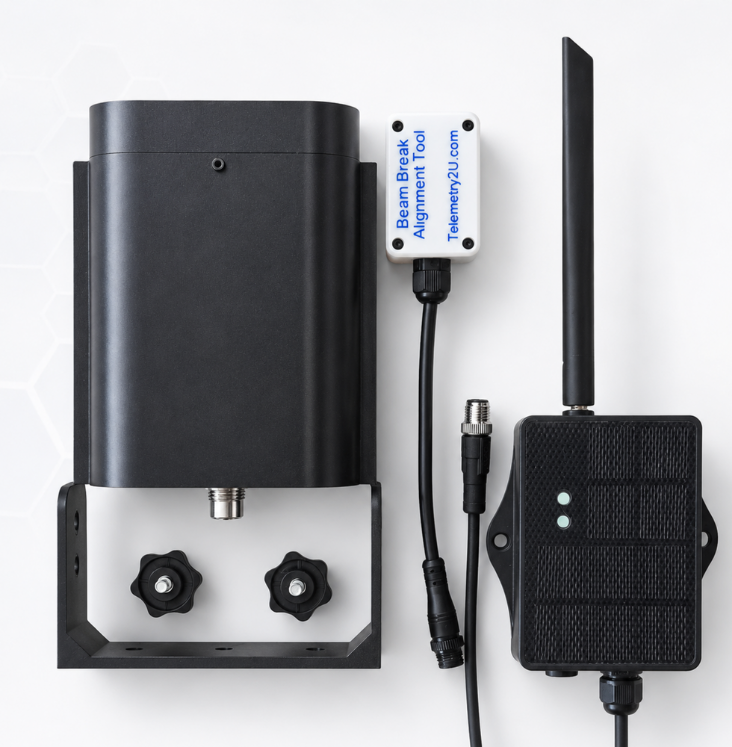
A Plug-and-Play System for Remote Locations
Most systems can be supplied pre-wired to a compatible Dragino contact and pulse node. The installer mounts the sensor, positions the reflector, confirms alignment and powers on the node. Telemetry2U then provides the dashboard, event records and alert rules.
- Power at one end only: The opposite reflector is passive and requires no cable, battery or radio.
- Solar-ready operation: Low sensor current suits solar-powered LoRaWAN, NB-IoT and LTE-M installations.
- Pre-wired telemetry node: Plug-and-play bundles can arrive connected and configured for the selected network.
- Audible field alignment: The supplied plug-in tool provides a simple way to aim the sensor at the reflector.
- Standard reflector plate: A round reflector with retroreflective tape is mounted at the far side using a single fixing point.
- Flexible installation: Use the supplied mounting bracket on a suitable post, wall or structure without Telemetry2U supplying the pole itself.
- Sensor-only option: Integrators can connect the open-collector output to another compatible input or pulse counter.
The sensor is designed by Telemetry2U, manufactured and assembled in Australia, and supplied internationally as an exclusive Telemetry2U product.
Turn Every Beam Interruption into a Useful Telemetry2U Record
Live Status, Counts and Event History
Telemetry2U turns a simple contact transition into a timestamped record that can be reviewed from a phone, tablet or computer.
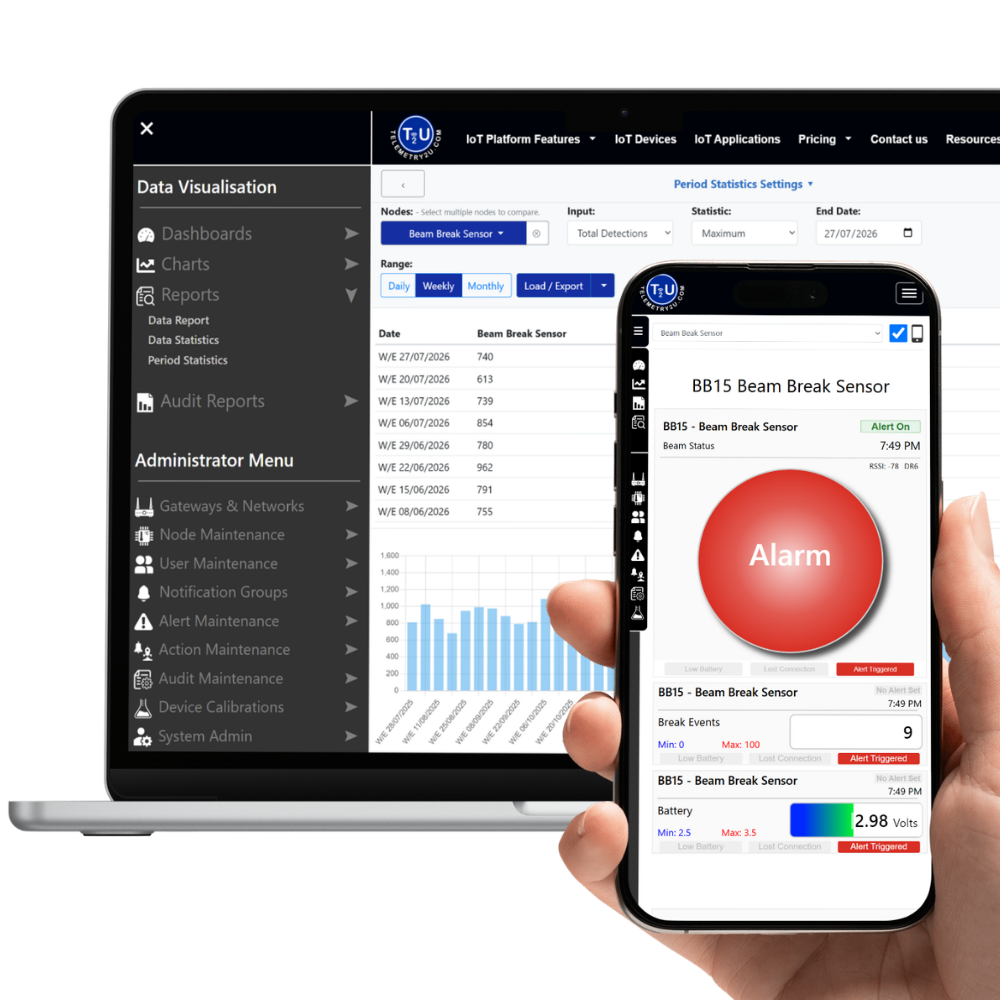
Review live beam status, alert conditions, crossing counts, battery voltage and historical event statistics from desktop, smartphone or tablet.
Notify the Right People at the Right Time
Record every crossing while applying alerts only when they are useful. A driveway can notify around the clock, a worksite can alert only overnight, and an operational counter can upload totals without notifying anyone.
- Current beam state: Show whether the connected input is clear or interrupted.
- Timestamped event history: Review when activity occurred and how frequently it happened.
- Crossing totals: Display daily, weekly or period-based counts where the node reports them.
- Scheduled notifications: Send email, SMS or voice alerts during selected periods.
- Node health: Review last communication, network status and battery information where supported.
- Reports and exports: Use historical records for operational review, security follow-up or research analysis.
A periodic keep-alive confirms that the telemetry node remains online. It does not independently prove that the sensor is connected or that the optical path remains aligned.
Wireless Driveway Alarms and Beam-Break Applications Across Remote Sites
A driveway alarm is the lead application: it can provide early warning as a vehicle, person or animal enters a property, before activity reaches a home, shed, yard or worksite. The same beam event can also support after-hours monitoring, operational counting and long-term trend analysis.
Driveway Alarms, Gates, Roads and Remote Property
Detect activity across an entrance or access path without running mains power or communications cable to both sides.
Early-Warning Driveway Alarm
Receive an alert when a vehicle, person or animal crosses a driveway, gate opening or private access lane—before it reaches buildings or equipment.
After-Hours Monitoring
Record all events while sending alerts only overnight, outside business hours or on selected days.
Remote Yards and Compounds
Add activity monitoring to equipment yards, storage areas, utility sites and unattended facilities.
Rural Roads and Farm Tracks
Monitor isolated tracks and property entrances where solar power and wide-area communications are more practical than local wiring.
Vehicles, Livestock, Equipment and Field Research
Connect the level output to a compatible counter or interrupt input for event totals, activity trends and operational records.
Vehicle Movement Counting
Count total crossings at a driveway, access road, loading area or low-traffic vehicle lane.
Livestock and Animal Movement
Record passages through a race, gate or controlled opening when beam height and animal size are suitable.
Machinery and Process Events
Count objects, equipment movements, conveyor passages or production events where one optical crossing represents one cycle.
Wildlife and Research Monitoring
Support temporary or long-term movement studies where a defined beam path provides useful activity data.
From a Broken Beam to a Recorded Event and Alert
The detector produces a level output while the beam is interrupted. A compatible telemetry node can count the event, transmit it immediately or retain totals for periodic reporting according to the selected configuration.
A Simple Four-Step Monitoring Workflow

Align
Mount the sensor and reflector, then use the supplied audible tool to confirm the optical path before securing the installation.
Detect
The pulsed infrared sensor checks the reflector about 100 times per second and changes its output when the beam is interrupted.
Count or Transmit
The connected node can count qualified transitions locally, send each event or upload accumulated totals at a configured interval.

Alert and Review
Telemetry2U records the event, updates dashboards and applies notification schedules, thresholds and escalation rules.
Hardware Designed for a Straightforward Field Installation
The application is normally supplied as a complete configured monitoring system. Customers who already have suitable equipment can also purchase the beam sensor separately and connect its open-collector output to a compatible input.
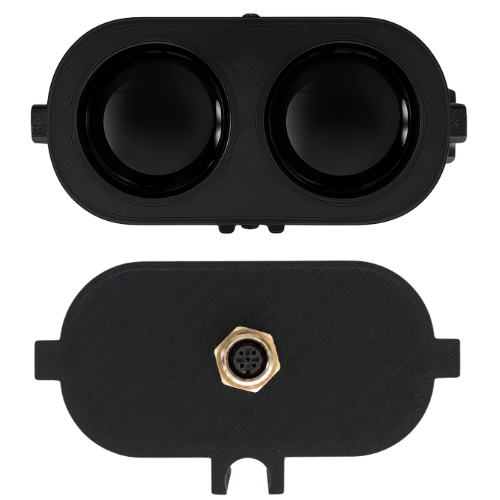
Long-Range Beam Sensor and Bracket
The pulsed infrared sensor is designed for a recommended 1–15 metre sensor-to-reflector distance and supplies a pull-to-ground open-collector output.
- 2.7–5.5 V DC supply range
- Approximately 100 Hz optical sampling
- ASA-CF enclosure material
- Mounting bracket and rear connector supplied
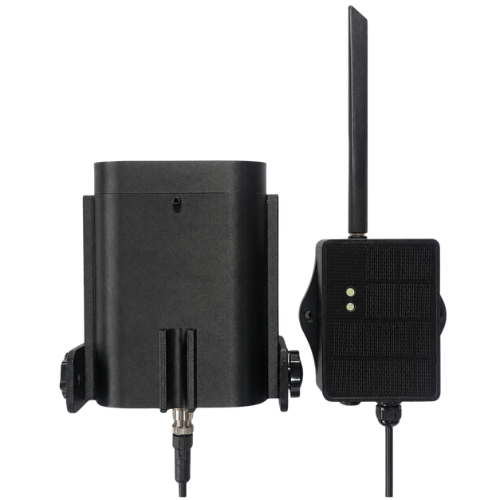
Pre-Wired Solar Telemetry Node
The normal Telemetry2U package is supplied connected to a compatible outdoor contact and pulse node for simple deployment and remote reporting.
- LoRaWAN CPL03-LS option
- NB-IoT and LTE-M CPL03-CS option
- Event-driven or periodic reporting
- Node status and battery information where supported

Reflector Plate and Alignment Tool
The passive reflector requires no power. The audible alignment accessory plugs into the sensor during installation and is removed after setup.
- Standardised round reflector
- Single-point reflector mounting
- One-person alignment process
- No electronics required at the far side
LoRaWAN, NB-IoT and LTE-M Beam-Break Monitoring Options
The best network depends on the property, coverage, gateway availability, event frequency and required notification speed. Telemetry2U can bring devices from all three network types into the same dashboards and alert workflows.

NB-IoT for Distributed Remote Sites
NB-IoT provides direct cellular communication where suitable carrier coverage is available and a local gateway is not preferred.
- Direct cellular connection
- Useful for dispersed fixed monitoring points
- Event timing depends on the cellular network and node configuration

LoRaWAN for Fast Local Event Reporting
LoRaWAN is well suited to properties, farms and facilities where a gateway can receive low-power event messages from one or many beam sensors.
- Long-range low-power communication
- Immediate event uplinks where configured
- One gateway can support many monitoring devices

LTE-M for Direct Cellular Monitoring
LTE-M can suit sites needing direct cellular connectivity, more frequent interaction or lower latency than a typical NB-IoT deployment.
- No local gateway infrastructure
- Suitable for geographically separated sites
- Power budget and signal coverage must be assessed
Use the Network That Fits the Location
A gate near an existing LoRaWAN gateway, an isolated rural road and an international cellular deployment can all use the same Telemetry2U platform while retaining the network best suited to each site.
Long-Range Detection Designed for Solar and Battery Power
The sensor does not run its high-power infrared emitter continuously. It uses short optical pulses and sleeps between measurements, providing useful outdoor range while keeping the average sensor current below one milliamp.

Useful Optical Range Without a Large Continuous Load
The current measurements show a normal-state draw of approximately 174–255 µA and a triggered-state draw of approximately 251–373 µA across the measured supply range. The complete solar power budget must also include the telemetry node, radio transmissions, battery and charging losses.
- Recommended distance: 1–15 metres between sensor and reflector.
- Optical sampling: Approximately 100 checks per second.
- Reliable event design: Allow about 10 ms or longer for a phase-independent interruption to be detected.
- Output behaviour: The output remains active while the interruption continues rather than producing a fixed pulse.
- Supply range: 2.7–5.5 V DC.
- Integration output: Open collector, pulling to ground when a qualified interruption is detected.
- Outdoor use: The design has been tested in direct sunlight; final site performance still depends on mounting, line of sight and reflector alignment.
The detector itself does not maintain the crossing count or send radio messages. Those functions are handled by the connected node, allowing the system to be configured for immediate events, periodic totals or a combination.
Related Security, Alerting and Wireless Monitoring Resources
Explore related applications, platform functions, wireless-network guidance and hardware options for building a complete driveway, gate or remote-site monitoring system around the BB15 beam-break sensor.

Security and Access Applications
Review related monitoring applications for security, gates, vehicles and assets across remote properties and facilities.
Dashboards, Alerts and Reporting
See the platform functions that turn beam interruptions into live status, notifications, counts and historical records.
Connectivity and Hardware
Compare wireless networks, review the BB15 kit and discuss the hardware configuration best suited to the installation.
Wireless Driveway Alarm and Beam-Break Monitoring FAQ
Answers to common questions about driveway alarms, detection range, solar power, vehicle counting, wireless networks, alert schedules and third-party integration.
Yes. The beam can be installed across a driveway, gate or access lane. When a vehicle, person or animal interrupts it, the connected telemetry node records the event and can trigger a Telemetry2U alert, providing early warning before activity reaches buildings or equipment.
The recommended sensor-to-reflector distance is 1 to 15 metres. Final range and alignment tolerance depend on reflector position, mounting stability, line of sight and site conditions.
No. The reflector is passive. Power, wiring and communications are required only at the sensor end, which simplifies installation across driveways, tracks, gates and other areas where running cable to both sides would be difficult.
Yes. Each qualified beam interruption can be counted by a compatible telemetry node or pulse counter. The detector itself presents a HIGH or LOW output rather than maintaining an internal event counter.
No. A single beam can detect and count crossings, but it cannot distinguish one direction from the other. Bidirectional entry and exit counting requires two separately positioned beams and suitable direction-processing logic.
Yes. Telemetry2U can record events continuously while notifications are configured for 24-hour operation, selected days, overnight periods, outside business hours or other defined schedules.
Yes. The sensor provides an open-collector pull-to-ground output for connection to compatible digital inputs, interrupt inputs and pulse counters. Electrical compatibility and input configuration must be confirmed for the selected device.
No. A keep-alive confirms that the telemetry node is communicating. It does not independently verify the sensor connection, optical alignment, reflector position or condition of the beam path.
Add Long-Range Beam-Break Monitoring to Your Site
Tell Telemetry2U the monitoring distance, site location, expected activity, preferred network and whether you need immediate alerts, periodic counts or both. We can supply the sensor as a pre-wired plug-and-play kit or assess compatibility with another digital-input or pulse-counting node.